Strength & Power • 7 minutes • Veronica Paddy
When golfers ask me how to hit it further, they usually expect me to talk about the gym. They are half right. Distance comes from clubhead speed, and clubhead speed is the product of strength, sequencing, and mobility. The lever you can move fastest as an amateur is rotational core power.
Notice the word rotational. Crunches and sit-ups will not help your swing. The golf swing is a rotational, anti-rotational, and counter-rotational event. Your training should look the same.
The five exercises
1. Cable or band rotational chops
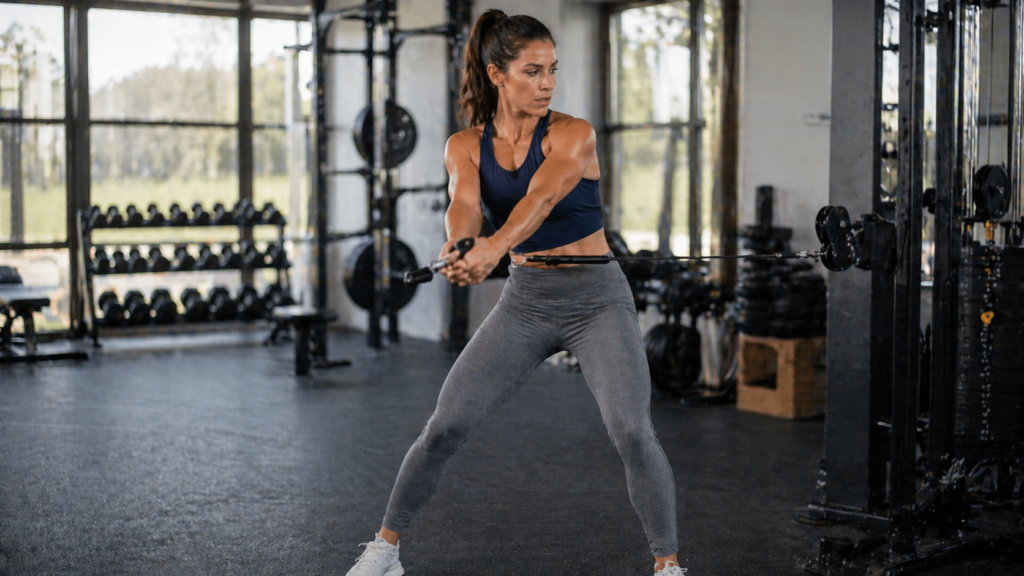
Stand side-on to a cable column or a band anchored at chest height. Feet shoulder-width apart. Pull the handle across your body in a chopping motion, rotating from the hips and trunk while keeping your arms relatively straight. 3 sets of 8 reps each side. This trains the same sequence your downswing uses, in the same plane.
2. Medicine ball rotational throws
Stand a metre from a wall, side-on. Hold a 3 to 5 kg medicine ball at hip height. Wind back, then explode through the hips and throw the ball into the wall. Catch and repeat. 3 sets of 6 reps each side. The keyword here is intent. This is a power exercise, not a conditioning one. Throw hard, rest fully.
3. Pallof press
Anchor a band at chest height and stand side-on. Press the handle straight out from your sternum and hold for 3 seconds. The band wants to pull you into rotation; your job is to resist. 3 sets of 10 reps each side. This is anti-rotation, and it is what stops your swing from collapsing under load.
4. Half-kneeling cable lift
Drop to one knee, with the cable column on the side of the down knee. Pull the handle from low-hip up and across your body to high-shoulder. 3 sets of 8 reps each side. The half-kneeling position locks out your hips and forces your trunk to do the work.
5. Suitcase carry
Pick up one heavy dumbbell or kettlebell. Walk 20 metres. Swap hands and walk back. The asymmetric load forces your obliques and quadratus lumborum to stabilise the spine. 3 to 4 trips per side. Your core has to fight rotation while you walk, which is exactly what it does in your swing.
How to programme it
Two sessions a week, on non-consecutive days. Pair this work with your existing strength training, or use it as a standalone golf-fitness block in the off-season. Expect to feel a difference in stability within three weeks and in clubhead speed by week six to eight.
A word on bulk
Female golfers in particular sometimes worry about bulking up. Rotational core training does not produce bulk. It produces a stiffer, more responsive trunk that transfers force from your hips to the club more efficiently. You will feel stronger and look leaner, not bigger.