Golf Fitness • 6 minutes • Veronica Paddy
Most amateur golfers I meet have hit a wall. They have taken lessons, bought new clubs, watched the YouTube videos, and yet their handicap has not budged in two years. The frustrating part is that they are usually working hard. The problem is rarely effort. It is almost always information.
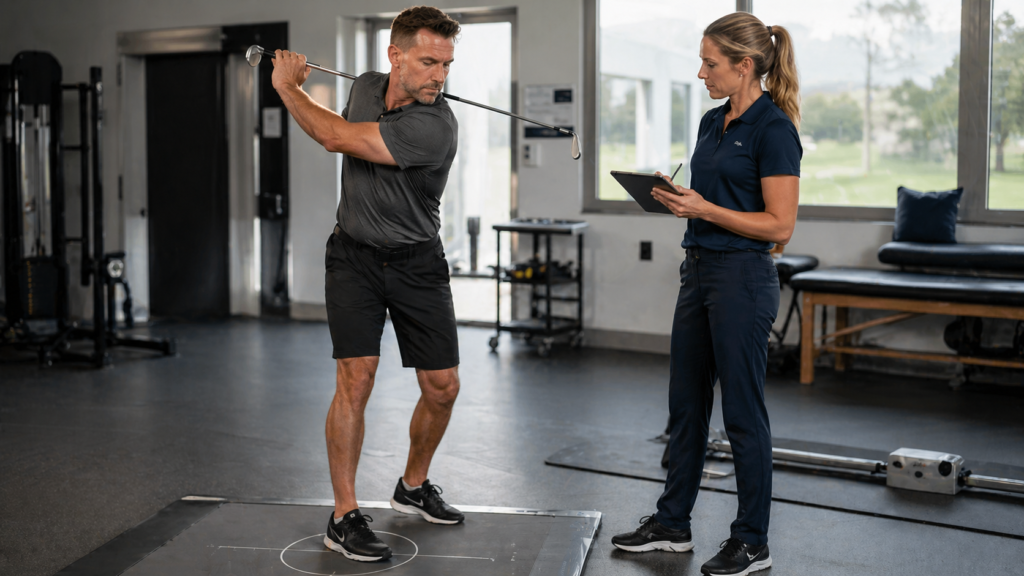
That is exactly what a Titleist Performance Institute (TPI) screen is designed to fix. It is not a lesson. It is not a fitness test. It is a structured physical assessment that asks one simple question: what is your body actually capable of when you swing a golf club?
What a TPI screen looks like
A full TPI screen is a sequence of around 16 movements, performed off the course, in roughly 30 to 40 minutes. We look at things like pelvic tilt, thoracic rotation, shoulder mobility, single-leg balance, hip internal rotation, and core stability. Each movement is scored against a known standard. Together, they paint a picture of where your body is helping your swing and where it is forcing you to compensate.
Why this matters more than another lesson
Here is the principle that changed how I coach: a swing fault is almost always a body fault expressed through a club. If you cannot rotate your upper body independently of your lower body, no amount of drilling a one-piece takeaway will fix your over-the-top move. Your body will simply find another compensation. Lessons stack on top of physical limitations. They rarely remove them.
This is why golfers plateau. They keep working on the symptom and never address the cause.
Three patterns I see again and again
Limited thoracic rotation. The mid-back is stiff, often from years of desk work. The shoulders cannot turn fully without the hips also turning, which kills coil and power.
Loss of posture in the downswing. The golfer stands up out of the shot. Nine times out of ten, this is a glute-activation issue, not a swing-thought issue.
Reverse spine angle. The upper body tilts toward the target at the top of the backswing. This is one of the strongest predictors of lower-back pain in golf, and it is almost always rooted in poor hip mobility or core stability.
What you walk away with
After a screen, you receive a written report explaining what your body is doing well, what is limiting your swing, and a prioritised set of corrective exercises. The exercises are not generic. They are matched to your specific limitations. From there, we can build a training plan, communicate with your coach, and stop guessing.
If your handicap has been stuck and you are tired of treating symptoms, a TPI screen is usually the most useful 40 minutes you can spend on your golf this year.